
Authored by Xiaoquan (Claus) Zhang
Precis: A high-profile copyright dispute involving popular beverage brand LELECHA has shed light on how modifications that simply diverge from the author’s intended expression, even without negative connotations, may be held liable. It also highlights how the Chinese judiciary addresses compliance of moral rights in commercial settings.
On 24 February 2026, a high-profile copyright dispute involving popular Chinese beverage brand LELECHA ended as the Shanghai IP Court approved its withdrawal of an appeal, rendering the first-instance judgment final. On 13 March 2026, LELECHA issued a public apology to the two plaintiffs to mitigate the adverse effects of its infringing actions.
At its core, the case follows a familiar commercial formula, brand collaborations built around historical or cultural elements, but delivers a less familiar message: while often overlooked in practice, moral rights – the personal rights that belong to the creator of an original artistic, literary or intellectual work, over and above any economic rights they may have as a result of copyright – can carry decisive weight in compliance.
Case background
In the 1970s, the late Chinese painter Yang Zhiguang and his spouse and collaborator Ou Yang jointly created two portraits of Lu Xun, prominent Chinese writer and critic in 20th century Chinese literature. These artworks are the copyrighted works cited by the plaintiffs, Ou Yang and Yang Hong (Yang Zhiguang’s daughter).
Yilin Press had published collections related to Lu Xun, and LELECHA, operated by Shanghai Chatian Catering Management, launched a brand collaboration campaign in partnership with Yilin Press on 23 April 2024 (World Book and Copyright Day). The campaign paid tribute to Lu Xun, a towering figure in modern Chinese literature and a cultural icon whose visual image – featuring short hair, a thick moustache, a long white gown and often depicted holding a cigarette – has long circulated in artistic works derived from historical photographs.
As part of the campaign, LELECHA used a portrait highly similar to the plaintiffs’ works on product packaging and promotional materials, with the notable change of reversing the figure’s orientation and replacing the cigarette in Lu Xun’s hand with a cup of milk tea.
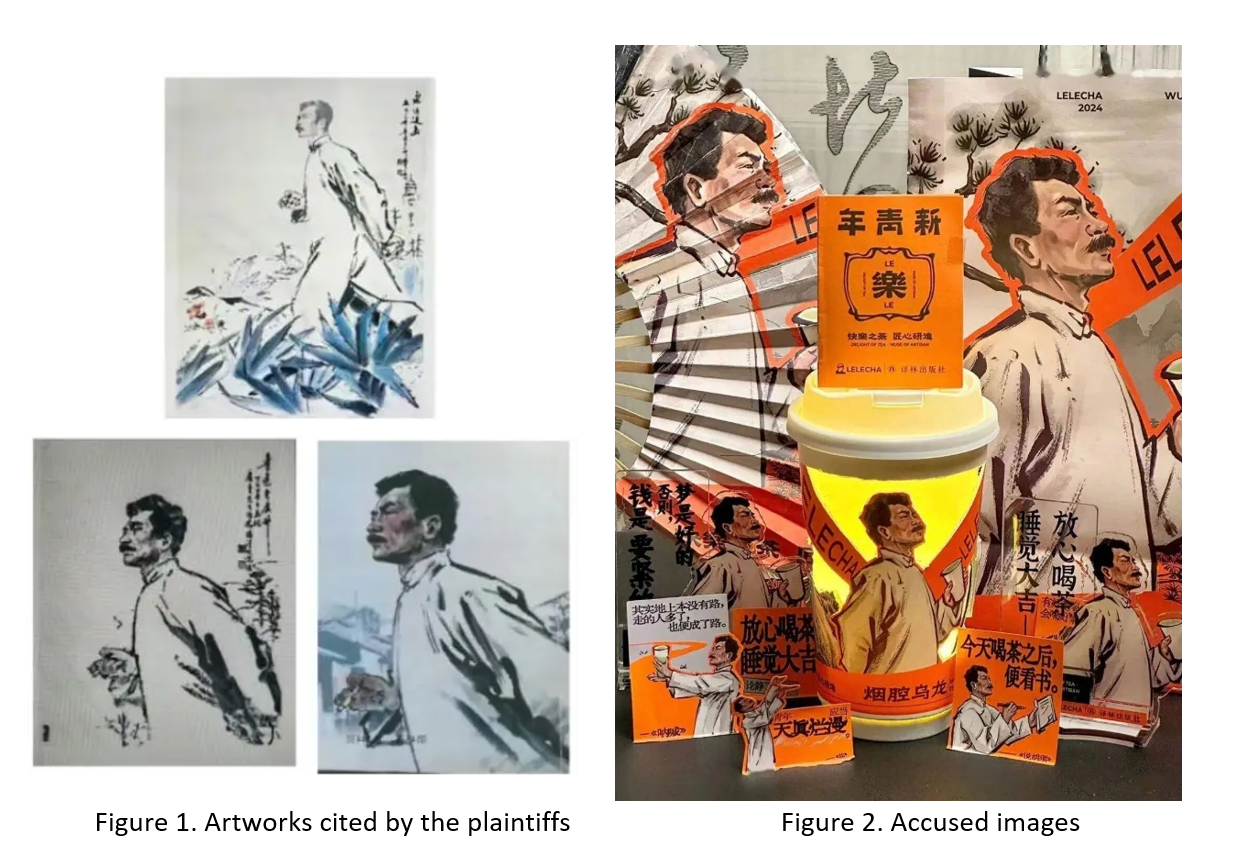
On 19 February 2025, the two plaintiffs filed a copyright suit against LELECHA and its affiliates, seeking cessation, 1 million yuan in damages and reasonable expenses, and a public apology.
Court decision
The first-instance court, the Shanghai Putuo District People’s Court, found that the accused images were substantially similar to the protected artworks. Aside from minor adjustments, such as reversing the figure’s orientation and substituting the cigarette with a beverage, the overall composition and expression constitute a slavish copy of the original.
Beyond confirming the infringement of reproduction, distribution and communication to the public, the court underscored the ramifications of the alteration, finding that replacing the cigarette with a cup of milk tea, while seemingly minor, departed from the authors’ creative intent and therefore infringed the right of modification. More importantly, the modification was found to have distorted the original work’s expression. The court noted that the altered image reshaped Lu Xun’s established persona – from a solemn and resolute intellectual figure into something more casual and commercial. This shift was held to be far from aesthetic as it disrupted the underlying emotional and ideological connotation of the original artwork, thereby impairing its integrity.
On this basis, the court concluded that LELECHA had infringed both the moral and economic rights of the copyright owners. It ordered damages of 200,000 yuan and granted the plaintiffs’ request for a public apology.
A lesson learnt for brand collaborations
This case reflects how the Chinese judiciary addresses compliance of moral rights in commercial settings.
Under China’s Copyright Law, moral rights include the rights of authorship, publication, modification and integrity. The prevailing perspective assumes that only distortions of the copyrighted works to the point of ridicule or defamation would be problematic. This case suggests otherwise. A modification that simply diverges from the author’s intended expression, even without negative connotations, may be held liable. This is particularly relevant in today’s branding landscape, where cultural symbols are frequently repackaged in playful or commercial contexts, sometimes in the name of ‘paying tribute’. This case suggests that this practice could be at fault if the underlying expression has been materially altered.
Another point worth noting is that, under Articles 10(2) and 10(3) of the Chinese Copyright Law, moral rights are neither transferable nor licensable. This means that the creators will remain be vested with such rights. As a result, it would be advisable for parties seeking to engage in adaptations or secondary creations of a copyrighted work to secure, where possible, separate written consent from the original creators, on top of obtaining authorisation from the owner that holds the economic rights over said work.